




Vysoká
The first written mention of Vysoká dates from 1388. The village is dominated by St Bartholomew’s Church, which offers an exceptional view over the Danubian Lowland.
In 1388 the village was called Magasfalu, and the name Wisoka is recorded from 1773; in Hungarian it was known as Viszóka or Magaslak, and in German as Wisoka or Hochberg. In 1388 the village belonged to Levice Castle and later to the Mining Chamber.
The villagers made their living from charcoal burning and woodcutting. Until 1940 there was a small brickworks in the village. In 1953 a collective farm was founded, which in 1960 was absorbed into the Banská Štiavnica State Farm. Some of the villagers worked in forestry and in industrial plants, mainly in Banská Štiavnica.
Until 1960 the village belonged to Hont County, the Banská Štiavnica district and the Banská Bystrica region. After 1960 it came under the Žiar nad Hronom district in the Central Slovak Region. Today the village has 124 inhabitants and belongs to the Banská Štiavnica district in the Banská Bystrica Region.
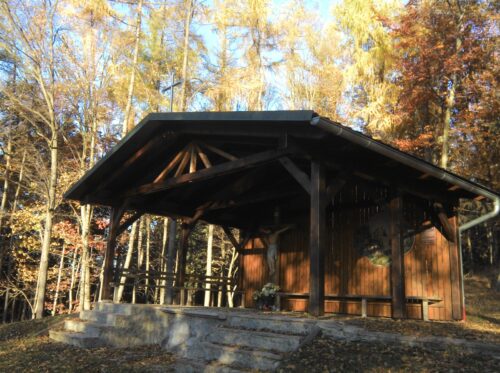
Between the villages of Uhliská and Vysoká, right on the red-waymarked Rudná magistrála long-distance trail, stands a large shelter. The pilgrimage site was built by people […]
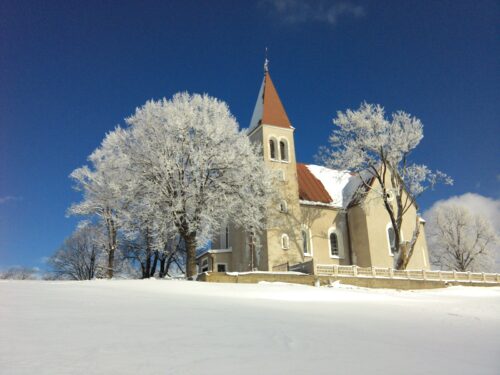
The village is dominated by St Bartholomew’s Church. Originally Baroque, it was restored in 1778 and 1820, and in 1867 it was rebuilt in a late […]