



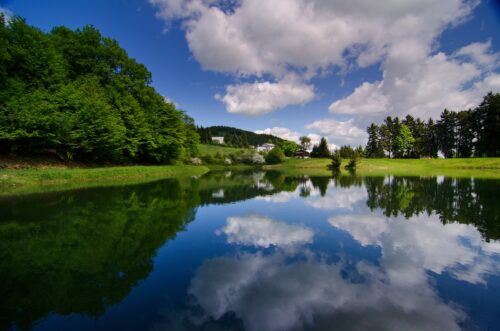

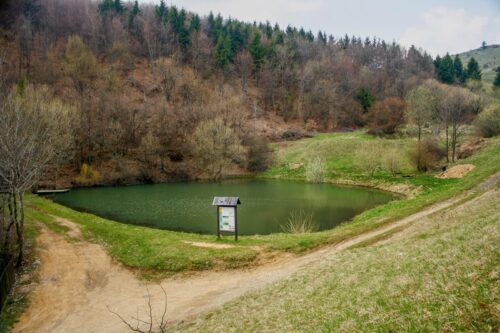


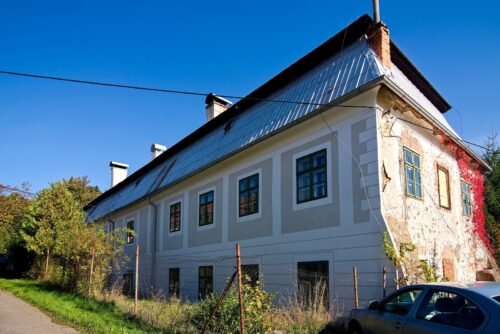


Originally called Piarg (from the German Berg), the village was formed by merging the mining settlements of Siglisberg and Windschacht. Štiavnické Bane was once the heart of mining in the whole region and, as such, of world importance.
Piarg was renamed Štiavnické Bane only in 1948, and the village of Horná Roveň was later joined to it. The Upper Bieber Adit was known as the ‘Mother of All Mines’, because it yielded more gold and silver than any other mine in the world had done until then. In 1627, the use of gunpowder for extracting ore was documented here for the first time in the world.
From 1735, Samuel Mikovíni taught mining specialists geometry, cartography and surveying here, later joined by geology, metallurgy and mining law. On this foundation the Mining Academy was established, the world’s first mining university, which trained experts for the whole world.
In 1710, Matej Kornel Hell submitted a proposal to the emperor in Vienna for the construction of tajch Veľká Vindšachta (a historic mining reservoir). Water from the tajch drove the pumps that drained groundwater from the flooded mines and saved mining in the Štiavnica Mountains for centuries to come. An ingenious system of 60 interconnected tajchs, together with underground tunnels and water-column pumps, formed the world’s biggest water engine.
The concentration of mining-related technical monuments here is so exceptional that the area was declared a heritage reserve of technical monuments. Today the Piarg tajchs are used mainly for recreation – for swimming and water sports in summer, and for ice skating and cold-water swimming in winter. You can walk and cycle along the old mining ditches, and go cross-country skiing on them in winter.
Tajch Bakomi, a tajch (a historic mining reservoir), was built between 1735 and 1737. According to Baron Ján Nepomuk Mitrovský, it was needed to make better […]
This tajch (a historic mining reservoir) lies in the village of Štiavnické Bane and is a little hidden away from the tourist crowds. Snack bars serving […]
Construction of this tajch (a historic mining reservoir) began in 1735 under the direction of Samuel Mikovíni. It was completed in 1737 and cost more than […]
Veľká and Malá Richňava were originally a single tajch (a historic mining reservoir), built for the needs of mining. Because the dam was not watertight, the […]
This is one of the village’s old historic buildings, in which a miners’ hospital was set up. It was founded in 1648. It served as an […]
This tajch (a historic mining reservoir) in Štiavnické Bane is still one of the largest in the area. Its dam was built in 1710 on the […]
This building in the middle of the village, below the road, was built in the Baroque style in the second half of the 18th century on […]
This almost forgotten Calvary, with its avenue of lime trees and stone reliefs, is probably even older than its sister in Štiavnica. On a spoil heap […]
Three tajchs (historic mining reservoirs) in a single photograph – that is one way to enjoy a trip to tajch Bakomi. Just above it, on a […]
Manage cookies
To provide the best experience, we use technologies such as cookies to store and/or access device details. Consenting to these technologies will allow us to process data such as browsing behaviour or unique IDs on this site. Not consenting or withdrawing consent may adversely affect certain features and functions.
Cookies are small text files that websites can use to make the user’s experience more efficient.
The law states that we can store cookies on your device if they are strictly necessary for the operation of this site. For all other types of cookies we need your consent. This means that cookies categorised as necessary are processed on the basis of Art. 6(1)(f) GDPR. All other cookies, i.e. those in the preferences and marketing categories, are processed under Art. 6(1)(a) GDPR.
This site uses different types of cookies. Some cookies are placed by third-party services that appear on our pages.
You can change or withdraw your consent at any time from the Cookie Policy on our website.
Our Privacy Policy explains who we are, how you can contact us and how we process personal data.
When contacting us about your consent, please quote your consent ID and the date.