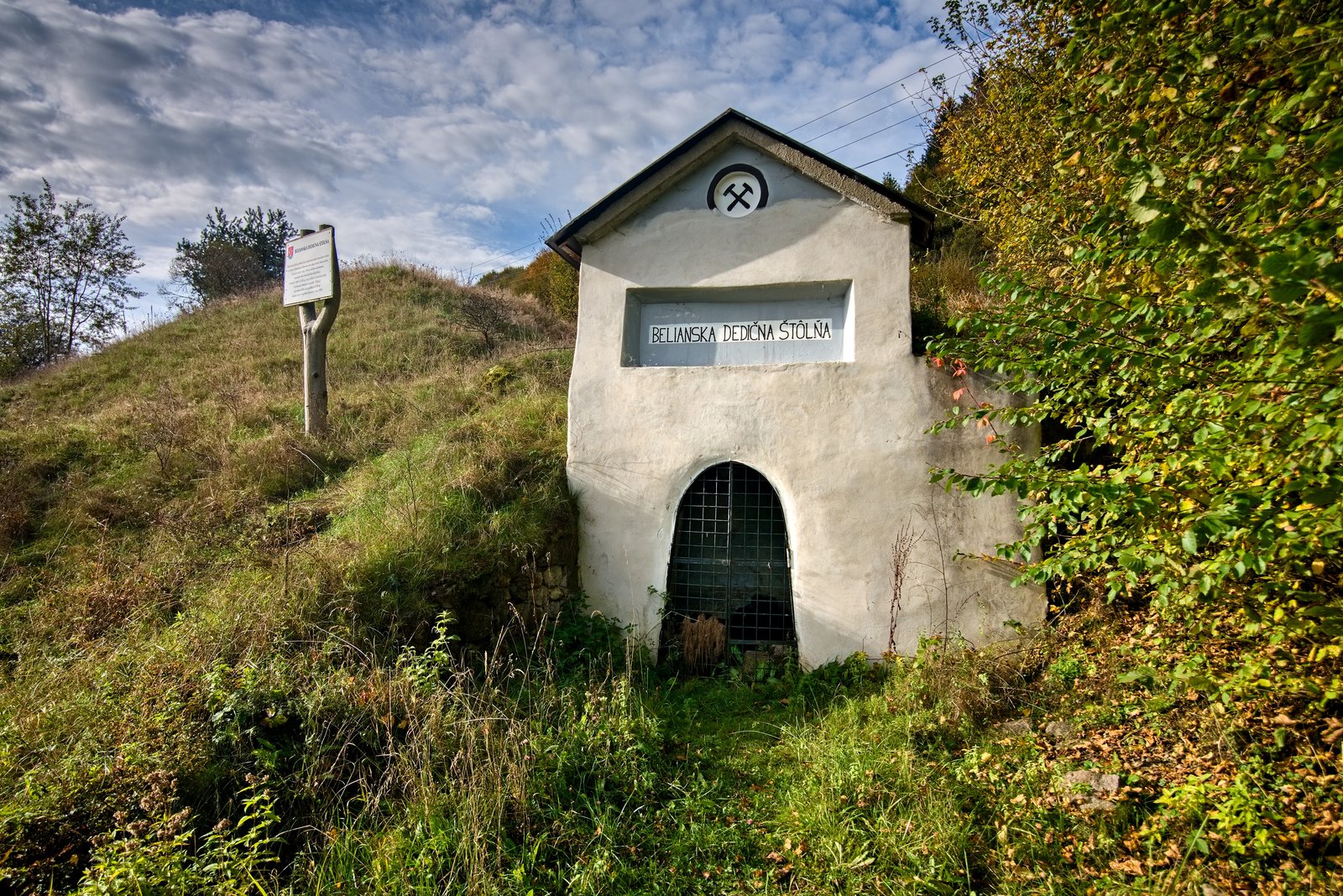

The Belá Hereditary Adit is part of the UNESCO World Heritage site.
Excavation beganas early as 1505, its total length is 8,700 m, and in the years 1608–1638 alone 91,249 gold florins were invested in its excavation.
Great hopes were pinned on it – it was meant to drain the flooded mines and open up new deposits expected to lie to the west. Disappointment set in when the adit reached the richest parts of the Siebenweiber vein, which had already been mined out, and the rest proved not very profitable.
The tunnels were driven by hand, using a miner’s hammer and chisel. The most important owner of the hereditary adit was the town of Banská Belá, and the state treasury provided subsidies for it. In 1746 it was proposed to extend the adit towards Banská Štiavnica, but the plan was never carried out. The last reconstruction of the adit took place in 1939–1950, after which it was decided to end mining in the Banská Belá area.
The adit mouth lies in the Kozelník valley at an altitude of 428 m above sea level, beside the road to Kozelník.