








Banská Belá takes its name from its mining heritage – the land around the village was laced with ore veins rich in gold, silver and other precious metals.
At first, precious metals around Belá were extracted from the surface, possibly as early as the time of Celtic settlement. Underground mining probably began only with the arrival of German miners in the 13th century. The oldest surviving written mention of the village dates from 1228, when the Bela area and the Bela stream are first recorded in connection with silver mines. The settlement took its name, Bela Baňa, from the stream; the Hungarians translated it as Feyerbanya, while the German colonists called it Diln.
Banská Belá had already been granted town rights before 1453. The young town developed promisingly, and stamp mills, a hammer mill and smelters for processing the ore sprang up in the valley towards Kozelník. By the 15th century at the latest, together with Kremnica, Banská Štiavnica, Banská Bystrica, Pukanec, Nová Baňa and Ľubietová, it had become a full member of the Union of Seven Mining Towns. Ferdinand I granted the town its coat of arms in 1563, as confirmed by a stone coat of arms from 1590, now kept in the lapidarium of the Old Castle in Banská Štiavnica.
A gradual decline set in during the 16th century: the quality of the ore fell, the cost of mining it rose, and groundwater kept breaking into the mines. The free royal mining town of Banská Belá lived in the shadow of Banská Štiavnica until 1788, when the two towns merged into the twin town of Banská Štiavnica and Banská Belá. The village later became independent again.
A pleasant walk to the Jasenica reservoir and Halčiansky tajch (a historic mining reservoir) starts at the Dinas works and follows the route of the former narrow-gauge railway, the ‘Štiavnická Anča’ – it will take you all the way to Banská Štiavnica (3 km). Heading the other way, you come into the village, past the U Gabriely inn and up to the churches. The church steps lead down to the monastery, a chapel and the former town hall. From the churches you can cross above the school grounds to the foot of Vraný kopec, from where a lovely path leads all the way to the Banská Štiavnica Calvary (3 km). There are also 40 km of waymarked mountain-bike routes around the village.
More about the village: banskabela.sk
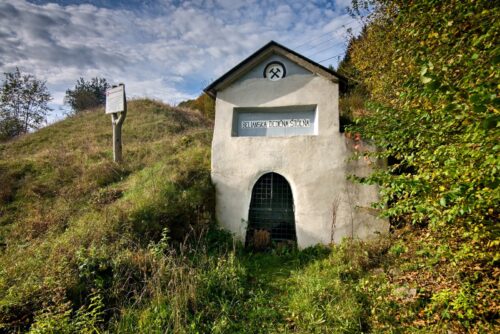
The Belá Hereditary Adit is part of the UNESCO World Heritage site. Excavation beganas early as 1505, its total length is 8,700 m, and in the […]
This spacious playground in the village of Banská Belá has climbing frames, slides, swings, a lookout tower, a climbing wall and a ‘bear’s den’. There’s also […]
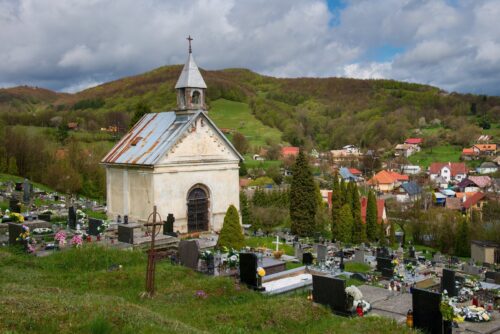
The Chapel of St Elizabeth stands in the local cemetery above the village. It was built on the initiative of the then parish priest, Anton Oldinger, […]
The Chapel of St John of Nepomuk stands right beside the main road. It was built in 1756 thanks to Andrej Hertinger, then a town senator […]
In the 15th century, miners had a small chapel dedicated to Our Lady of Mount Carmel built here, directly above the shaft in which they had […]
Carnival processions, the burning of Morena (a straw figure symbolising winter), pork specialities from the traditional pig slaughter, mulled wine, the mock burial of the double […]
The deeper the miners dug, the more groundwater had to be pumped out. To drive the pumps, the world’s biggest water engine was created here, made […]
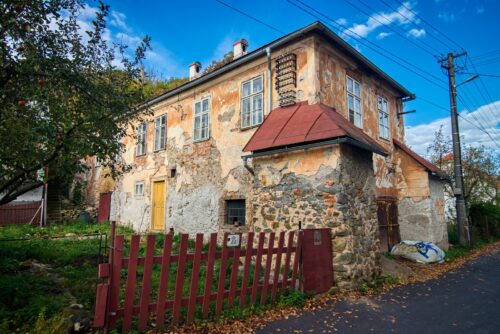
The former town hall was probably built in 1590. On the ground floor is a vaulted hall that served as a guardroom for the town police […]
The church is the oldest and most important landmark in Banská Belá. It was built in the mid-13th century. The sanctuary is dominated by a wooden […]
From the centre of Banská Štiavnica, across the Kysihýbel Aqueduct and through the village of Kozelník all the way to Hronská Breznica, the route runs through […]
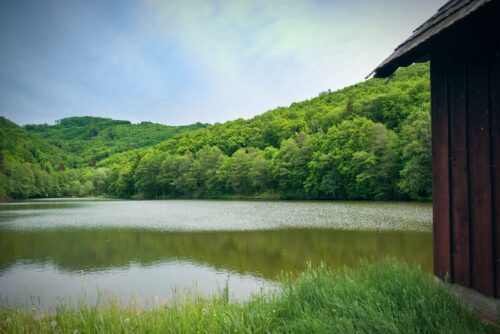
Many locals say that Beliansky tajch is one of the warmest of all the tajchs (historic mining reservoirs). It lies just below the hill of the […]
Vilabela stands at the far end of the picturesque village of Banská Belá, not far from historic Banská Štiavnica, at the foot of the Štiavnica Mountains. […]
Manage cookies
To provide the best experience, we use technologies such as cookies to store and/or access device details. Consenting to these technologies will allow us to process data such as browsing behaviour or unique IDs on this site. Not consenting or withdrawing consent may adversely affect certain features and functions.
Cookies are small text files that websites can use to make the user’s experience more efficient.
The law states that we can store cookies on your device if they are strictly necessary for the operation of this site. For all other types of cookies we need your consent. This means that cookies categorised as necessary are processed on the basis of Art. 6(1)(f) GDPR. All other cookies, i.e. those in the preferences and marketing categories, are processed under Art. 6(1)(a) GDPR.
This site uses different types of cookies. Some cookies are placed by third-party services that appear on our pages.
You can change or withdraw your consent at any time from the Cookie Policy on our website.
Our Privacy Policy explains who we are, how you can contact us and how we process personal data.
When contacting us about your consent, please quote your consent ID and the date.